What are your roles within GLIOMATCH and at KU Leuven?
Dr. Chiara Caprioli is a postdoctoral researcher in the laboratory of Prof. Frederik De Smet. Within GLIOMATCH, she supervises the collection of a large amount of clinical data and patient samples and is directly involved in the subsequent data analysis.
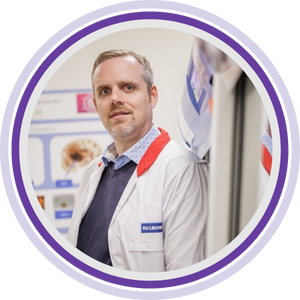
Prof. Frederik De Smet is a professor at KU Leuven and the coordinator of the GLIOMATCH project.
Why is glioblastoma so difficult to treat, and how is GLIOMATCH addressing this challenge?
According to Dr. Caprioli, glioblastoma is an extremely heterogeneous disease. There is substantial variation between patients, but also between different tumour cells within the same patient.
This heterogeneity makes glioblastoma difficult to treat, while the available therapeutic options remain limited and often poorly effective.
GLIOMATCH aims to improve this situation by identifying biomarkers that connect the characteristics observed in a patient’s tumour tissue with their response to different immunotherapy regimens.
What was the main question addressed by the study?
Dr. Caprioli explains that the study aimed to understand what happens to the tumour tissue of patients receiving standard-of-care treatment and whether these changes could help explain their response to therapy.
To investigate this, the researchers analysed samples collected when patients were first diagnosed and samples taken from the same patients when their tumour recurred.
Prof. De Smet explains that the team used single-cell and spatial technologies to map the individual cells within each tumour. This allowed them to examine how the tumour composition changed from diagnosis, throughout treatment and up to recurrence.
What are the study’s most important findings?
The researchers identified distinct subgroups of patients based on the characteristics of their tumour tissue and how those characteristics changed over time.
According to Dr. Caprioli, these patient groups responded differently to treatment according to their tissue features. By characterising the tumour microenvironment in greater detail, the researchers also identified two distinct types of microenvironment, each shaped by different modulatory molecules.
From the patient perspective, one of the most important findings was that the tissue features identified by the researchers could help predict response to second-line treatment after relapse.

How does the glioblastoma ecosystem change during treatment?
Prof. De Smet explains that patients generally begin with standard-of-care treatment consisting of radiotherapy combined with the chemotherapy drug temozolomide. As treatment progresses, the tumour begins to change.
The study showed that these changes do not follow the same pattern in every patient. Instead, the researchers identified multiple tumour evolution trajectories.
Depending on how the tumour evolved, patients showed different levels of sensitivity to therapy and different clinical outcomes. Some patients had much better outcomes than others, and these differences were closely aligned with changes in the tumour at the cellular level.
What distinguishes the different patient trajectories?
According to Prof. De Smet, the trajectories reflect differences in how the composition of each patient’s tumour changes between diagnosis and recurrence.
Some tumours evolve in a way that remains more sensitive to therapy, while others develop cellular characteristics associated with more aggressive progression and poorer outcomes.
The study therefore moves beyond analysing glioblastoma at a single point in time. It considers the tumour as a dynamic ecosystem that changes in response to treatment and follows different paths in different patients.
What makes the findings novel?
The study analysed almost 100 patients for whom paired tumour samples were available from diagnosis and recurrence. Prof. De Smet notes that this is among the largest cohorts assessed using these types of single-cell and spatial technologies.
The cohort was also accompanied by detailed clinical annotation. The researchers had information on the therapies received by each patient and on the relevant clinical parameters, allowing them to connect changes in tumour composition with treatment and outcome.
Dr. Caprioli emphasises that this detailed clinical information supports robust conclusions and provides resources that can be used to identify predictive biomarkers of response.
The resulting data also establish a new framework for grouping patients according to how their tumours are composed and how they evolve over time.
How could these findings support more personalised treatment?
Dr. Caprioli explains that the tissue could potentially be mapped at the beginning of the disease and used to develop a prognostic framework that may ultimately support therapeutic guidance.
The findings provide mechanistic insights into why some patients may not respond to treatment and how therapy could potentially be optimised, for example by combining standard treatment with other therapeutic molecules or approaches.
Prof. De Smet also highlights the potential relevance for patients whose tumours recur very quickly. These patients may be offered an alternative chemotherapy, but it is currently difficult for oncologists to know in advance who is likely to benefit.
The study found that response to this second chemotherapy was related to how the tumour composition had changed. The framework could therefore support improved patient stratification and help identify which patients are more likely to benefit from a particular second-line treatment.
How does the study contribute to GLIOMATCH?
The publication represents the first step in a longer research trajectory.
The initial study focused on patients receiving standard-of-care treatment. Within GLIOMATCH, the partners are now collecting comparable samples and performing similar analyses for patients receiving immunotherapy.
Prof. De Smet explains that the framework developed through this study can now be reused and further adapted to investigate whether specific immunotherapies are more or less effective for patients following particular tumour trajectories.
Dr. Caprioli adds that the original study was based on a relatively limited number of protein markers. Newer technologies now enable a much broader functional characterisation of tumour tissue.
GLIOMATCH will apply these technologies to better understand why certain patients do not respond to immunotherapy and how treatment strategies could be improved for those patients.
What are the expected long-term benefits for patients?
In the long term, the researchers hope that the framework will support better treatment selection for individual patients.
By understanding how a patient’s tumour is composed, how it changes during treatment and which tumour environments are associated with response or resistance, clinicians may be able to make more informed decisions about subsequent therapy.
The findings provide an important basis for GLIOMATCH’s wider goal of developing biomarker-driven patient stratification and enabling a more personalised matching of glioblastoma patients with suitable immunotherapy strategies.
The final publication and video interview will be available on our website shortly.
In the meantime, we invite you to discover the rest of our GLIOMATCH: Explained series on our video page.